Showing posts with label books. Show all posts

Friday, December 5, 2014

Our National Strife

I have just made it through Vol. I of Shelby Foote's Civil War - A Narrative, and it's absolutely captivating. Foote is a remarkable storyteller. I've always enjoyed history because, to me, good history just reads like a story, and most of the time the truth is more dramatic than fiction. Towards the end of the first volume (which is just about the winter of 1862), a passage struck me. 

Foote recounts a speech that Lincoln delivers to Congress in 1862, just as it had become clear to him (and others) that the Civil War was not going to be easily or quickly won.
Our national strife springs not from our permanent part, not from the land we inhabit, not from our national homestead. Our strife pertains to ourselves, to the passing generations of men, and it can without convulsion, be hushed forever with the passing of one generation.
                                                                                -Lincoln's Second Annual Address

To me, the idea that our national problems can be solved with a new generation  has an optimistic sound. Essentially, we may have troubles now, but the future generations of Americans can solve them simply by coming into existence. I guess it's a faith in the moral arc of the universe. The flip side to that coin is that it only takes one generation to lose what we presently have.

I guess the both are true. Anyway, it seemed particularly relevant to all of the national strife that we seem to have today.

Tuesday, November 11, 2014

Veterans Day: 2014

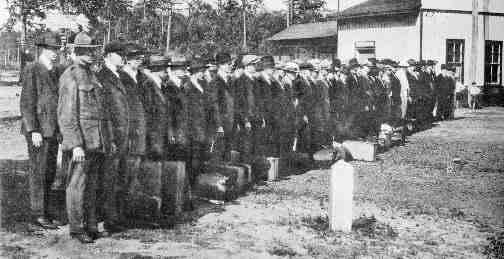
Parris Island Marine Corps Recruits, WWI

Today, we remember all our veterans, but to me, this day seems mostly about remembering the veterans of The Great War.
“The muffled tongue of Big Ben tolled nine by the clock as the cortege left the palace, but on history's clock it was sunset, and the sun of the old world was setting in a dying blaze of splendor never to be seen again.”
― Barbara W. Tuchman, The Guns of August

Wednesday, May 28, 2014

Douglas MacArthur in 1930

I'm most of the way through American Caesar, which is a biography on Douglas MacArthur. (Most of the way means that I've now gotten to the point where he has re-taken the Philippines. Anyway, it's an interesting read.

For instance, I had no idea how old MacArthur was. He was born in 1880. Yeah, that made him sixty years old when WWII broke out in 1940. Sixty.

 This is Douglas MacArthur in 1930, between the wars - before he was a household name.


He's 50 in this picture.

What's also interesting is the reaction I get from some people when I tell them I'm reading about MacArthur. He's still somewhat polarizing. Yes, he was arrogant, conceited, and flamboyant, but he was also an amazingly capable officer. His tactics/strategy very likely saved many lives, when compared to the Allied Operations in France and Italy, especially Italy.

Monday, October 21, 2013

What Books Should You Be Reading?

Happy Monday, y'all.

I was looking at my bookshelves this weekend and trying to decide how to best organize them. My house doesn't really have a great amount of bookshelves relative to the amount of books I've accumulated, so space is at a premium.

I'm pretty heavy into non-fiction, while Mrs. Permanent Press enjoys novels. You can pretty much go through our bookshelves with that in mind and figure out which books belong to whom. On Sunday, she and I were discussing which books that should be read in order to be a well-informed citizen to participate in our little constitutional republic as a reasonably informed person. We tried to come up with a top 5 list.

Obviously, there's the Constitution. That's kind of a gimme, like naming The Beatles in a list of top five bands. Barry from High-Fidelity wouldn't like it.

After some thought, here's what I came up with:

Top 5 Books You Should Read to be an Informed American
  1. Democracy in America
  2. The Federalist Papers
  3. Capitalism and Freedom
  4.  The Guns of August
  5. American Rifle
Democracy in America made the list as it is an outsider's view of America shortly after the revolution. The Federalist Papers made the list because they are probably the best "companion" to the Constitution that you could have. On economic matters, I wanted to include a work from Milton Friedman, hence Capitalism and Freedom. I liked it, but your mileage may vary. The Guns of August is in the list as a cautionary tale of how countries plunge into war. I thought about including a book on the Civil War and/or WWII, but I wanted to stick with my limit of five. Finally, I put American Rifle in on the list because the development of the rifle through our history had a profound impact on our country. Again, your mileage may vary.


Anyway, it's impossible to come up with a perfect list if you're held to only five books, but it's fun to try. Anybody think they can come up with a better list?

Monday, September 9, 2013

Advice from Clausewitz for Obama

When you're thinking over this whole Syrian intervention, it's always helpful to remember your Clausewitz. Here are a few helpful tidbits that the President should consider if we're going to war with Syria.
In any specific action, in any measure we may undertake, we always have the choice between the most audacious and the most careful solution. Some people think that the theory of war always advises the latter. That assumption is false. If the theory does advise anything, it is the nature of war to advise the most decisive, that is, the most audacious. Theory leaves it to the military leader, however, to act according to his own courage, according to his spirit of enterprise, and his self-confidence. Make your choice, therefore, according to this inner force; but never forget that no military leader has ever become great without audacity.
If you're not prepared to go forward boldly, it may be better not to go at all. Half-measures don't win battles. If you know your objective, go forward with confidence. What's our objective, again?

Here's more. Specifically, look at points #5 and #7.
The few principles, therefore, which come up in this connection, and which depend primarily on the condition of the respective states and armies, can in their essential parts be very briefly summarized:

1. General Principles

I. Warfare has three main objects:

(a) To conquer and destroy the armed power of the enemy;

(b) To take possession of his material and other sources of strength, and

(c) To gain public opinion.

2. To accomplish the first purpose, we should always direct our principal operation against the main body of the enemy army or at least against an important portion of his forces. For only after defeating these can we pursue the other two objects successfully.

3. In order to seize the enemy's material forces we should direct our operations against the places where most of these resources are concentrated: principal cities, storehouses, and large fortresses. On the way to these objectives we shall encounter the enemy's main force or at least a considerable part of it.

4. Public opinion is won through great victories and the occupation of the enemy's capital.

5. The first and most important rule to observe in order to accomplish these purposes, is to use our entire forces with the utmost energy. Any moderation shown would leave us short of our aim. Even with everything in our favor, we should be unwise not to make the greatest effort in order to make the result perfectly certain. For such effort can never produce negative results. Suppose the country suffers greatly from this, no lasting dis- advantage will arise; for the greater the effort, the sooner the suffering will cease.
The moral impression created by these actions is of infinite importance. They make everyone confident of success, which is the best means for suddenly raising the nation's morale.

6. The second rule is to concentrate our power as much as possible against that section where the chief blows are to be delivered and to incur disadvantages elsewhere, so that our chances of success may increase at the decisive point. This will compensate for all other disadvantages.

7. The third rule is never to waste time. Unless important advantages are to be gained from hesitation, it is necessary to set to work at once. By this speed a hundred enemy measures are nipped in the bud, and public opinion is won most rapidly. Surprise plays a much greater role in strategy than in tactics. It is the most important element of victory. Napoleon, Frederick II, Gustavus Adolphus, Caesar, Hannibal, and Alexander owe the brightest rays of their fame to their swiftness.
The tools of war change through the ages, but the philosophy of war does not. In addition to reading his theory, I would also assign The Guns of August to our President as some required reading. I have an old copy around somewhere that I can let him borrow.

Monday, May 13, 2013

The Guns at Last Light

The final book (The Guns at Last Light) in Rick Atkinson's WWII trilogy is finally out. I've read the first two; An Army at Dawn and The Day of Battle, and they're great.

Atkinson does a great job of giving the reader both the large, strategic points of view, and then zooming down in on key points on the individual soldier's level. He's taken a really long time to finish this trilogy. I think the second book came out in 2007, so this third book has been six years coming.

Hopefully, it is as good as the first two. SPOILER ALERT: Germany loses.


Sunday, November 4, 2012

Sunday Reading: WWII Posters and the Brooklyn Bridge

If you've seen my Twitter icon, it references this WWII propaganda poster that the British used. I decided to go with it while reading Churchill's epic memoirs of WWII. Seriously, it's a lot of reading, but it's good (if you like that sort of thing).


I've put my own little spin on it, but here's an interesting read on some of the other related posters and how the same ethos is applicable today.

On a related note, I've started an old book (new to me). It's David McCullough's "The Great Bridge". It's the story of the construction of the Brooklyn Bridge, which I thought was somewhat topical, given recent events. I'm still not through with Churchill's memoirs, but I'll double-fist it for awhile.

Wednesday, September 26, 2012

Audio of William Faulkner Teaching at UVA

I intended to post this yesterday (as it was William Faulkner's birthday) but the day got away from me. In any event, this is too cool to pass up. Faulkner is one of my favorite writers (and probably my favorite Southern writer). At some point, I really need to get to Oxford, MS to see his home (and the Grove), but I digress.
Thanks to the University of Virginia, a new audio archive of the author reading, lecturing, and answering questions has recently been published online, accessible to the public for the first time. Nearly fifteen years in the works, the vast archive encompasses almost thirty hours of audio transferred from open-reel tapes.
Here's the link to the UVA audio tapes.

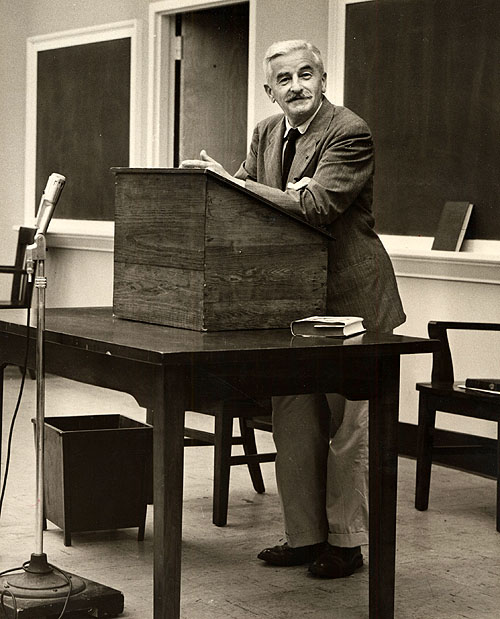
William Faulkner teaching at UVA in 1957
[H/T: Garden & Gun]

Tuesday, May 8, 2012

270-Year-Old Book Found in Charleston

It's a book about parties in the 1780s. I actually think the bigger finds are the letters that they came across in the same search.
The recent search of the archives has already turned up several other gems that librarians didn't know were there.
They include two letters written by Alexander Hamilton and a unique third letter written by John Marshall, chief justice of the U.S. Supreme Court, to South Carolinian Charles Cotesworth Pinckney, who helped draft the Constitution.
"It was written the day that Thomas Jefferson was sworn in (as president)," Kometer said. "John Marshall was the one who actually swore him in. He started a letter to Charles Coatesworth Pinckney in the morning and then he took a break and came back at 4 o'clock to finish the letter and said I have just administered the oath."
I don't have much of an interest in party etiquette, but a letter from Chief Justice John Marshall to Charles Pinckney would be pretty cool to see. I hope they will put the letters on display. I wonder what else is just laying around in the vault. It kind of reminds me of the last scene from "Raiders of the Lost Ark". I'm sure some "top men" put those letters in that vault.

Monday, January 30, 2012

Attention Kindle and other E-Reader Owners!

According to this guy, you're not a "serious reader".
I think, for serious readers, a sense of permanence has always been part of the experience. Everything else in your life is fluid, but here is this text that doesn’t change. … 
Someone worked really hard to make the language just right, just the way they wanted it. They were so sure of it that they printed it in ink, on paper. A screen always feels like we could delete that, change that, move it around. So for a literature-crazed person like me, it’s just not permanent enough.
In other news, Jonathan Franzen has come out against word-processing in favor of the traditional moveable type on the ol' Guttenburg press.
High-Tech Publishing